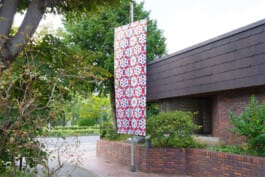
Exhibition at the Goethe-Institut Villa Kamogawa, Kyoto, Japan
In Between
(35°01′22.6″N, 135°46′21.9″E)
2025
Public art
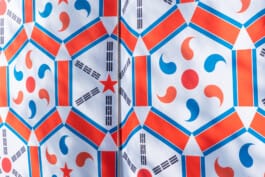
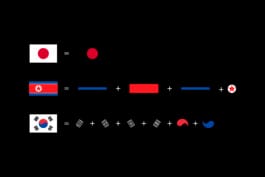
The Goethe-Institut Villa Kamogawa in Kyoto, Japan, has a designated space for flying its flag. During an art festival focused on migration, an artist raised a flag that deconstructed and reconfigured the motifs of the national flags of Japan, South Korea, and North Korea. The flag explores the “in-between“ identity of Zainichi Koreans who are a minority in Japan.
Zainichi Koreans are the descendants of people who migrated to Japan before 1945, when Korea was under Japanese colonial rule and before the country was divided by the Korean War. They are bilingual, speaking Japanese as their first language. Some hold South Korean passports and maintain connections with organizations linked to North Korea. Thus, they navigate the complex political relations among these three countries. Furthermore, they continue to face discrimination in Japanese society, which is a legacy of imperialist-era policies.
Prior to the modern era, Kyoto was Japan’s capital. The city’s traditional industries occupy an important place in Japanese cultural identity. However, few people know that Zainichi Koreans played significant roles in certain processes within the city’s kimono industry. The pattern of the reconfigured flag draws on the tortoiseshell motif (kikkō), a traditional East Asian design. This pattern is a classic design found in kimonos and also exists in traditional South Korean culture.
Those who live between multiple cultures often struggle with an unstable sense of identity. However, it is equally important to recognize their ability to transcend borders and serve as cultural bridges.
Other Works on Asien History
Exhibition at the Goethe-Institut Villa Kamogawa, Kyoto, Japan
In Between
(35°01′22.6″N, 135°46′21.9″E)
2025
Public art
The Goethe-Institut Villa Kamogawa in Kyoto, Japan, has a designated space for flying its flag. During an art festival focused on migration, an artist raised a flag that deconstructed and reconfigured the motifs of the national flags of Japan, South Korea, and North Korea. The flag explores the “in-between“ identity of Zainichi Koreans who are a minority in Japan.
Zainichi Koreans are the descendants of people who migrated to Japan before 1945, when Korea was under Japanese colonial rule and before the country was divided by the Korean War. They are bilingual, speaking Japanese as their first language. Some hold South Korean passports and maintain connections with organizations linked to North Korea. Thus, they navigate the complex political relations among these three countries. Furthermore, they continue to face discrimination in Japanese society, which is a legacy of imperialist-era policies.
Prior to the modern era, Kyoto was Japan’s capital. The city’s traditional industries occupy an important place in Japanese cultural identity. However, few people know that Zainichi Koreans played significant roles in certain processes within the city’s kimono industry. The pattern of the reconfigured flag draws on the tortoiseshell motif (kikkō), a traditional East Asian design. This pattern is a classic design found in kimonos and also exists in traditional South Korean culture.
Those who live between multiple cultures often struggle with an unstable sense of identity. However, it is equally important to recognize their ability to transcend borders and serve as cultural bridges.