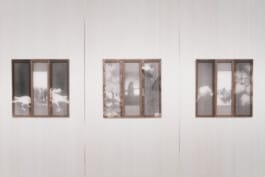
Exhibition at the Museum of Asian Art, Berlin
Ghosts
2024
Screen print on silk
Each: 93 × 93 cm
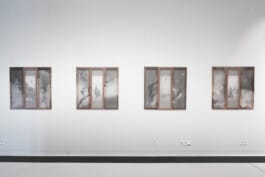
This silkscreen print is based on two historical sources. The first is a collection of Japanese paintings housed at the Asian Art Museum in Berlin. Japanese painting emerged after Japan’s modernization and the introduction of Western art. Although rooted in traditional premodern art, it was also influenced by Western art. During the militaristic era, some of these works were associated with political power and used for propaganda, depicting Japanese beauty.
The Japanese paintings that serve as the motif for this work were originally exhibited in 1931 at the Akademie der Künste in Berlin as part of an exhibition titled Gegenwart der japanischen Malerei (Contemporary Japanese Painting). While the Nazis had not yet come to power in Germany at that time, the same year saw the outbreak of the Manchurian Incident, which was launched by the Japanese Kwantung Army and marked an escalation of Japan’s control in northeastern China.
The second source is the Manshu-jiken shashincho (Photo Album of the Manchurian Incident), published in 1932 by the South Manchuria Railway Company in commemoration of the event. The company was formed to oversee the railway line that Japan acquired from Russia following the Russo-Japanese War (1904–1905). The company’s role extended far beyond transportation to include infrastructure, agriculture, industrial development, power generation, and hotel operations in the region.
These two sources seem to address different topics: art and the documentation of the “military operation.” Through this artwork, however, the artist explores the ideological similarities between these two pieces of propaganda from that period.
Other Works on Asien History
Exhibition at the Museum of Asian Art, Berlin
Ghosts
2024
Screen print on silk
Each: 93 × 93 cm
This silkscreen print is based on two historical sources. The first is a collection of Japanese paintings housed at the Asian Art Museum in Berlin. Japanese painting emerged after Japan’s modernization and the introduction of Western art. Although rooted in traditional premodern art, it was also influenced by Western art. During the militaristic era, some of these works were associated with political power and used for propaganda, depicting Japanese beauty.
The Japanese paintings that serve as the motif for this work were originally exhibited in 1931 at the Akademie der Künste in Berlin as part of an exhibition titled Gegenwart der japanischen Malerei (Contemporary Japanese Painting). While the Nazis had not yet come to power in Germany at that time, the same year saw the outbreak of the Manchurian Incident, which was launched by the Japanese Kwantung Army and marked an escalation of Japan’s control in northeastern China.
The second source is the Manshu-jiken shashincho (Photo Album of the Manchurian Incident), published in 1932 by the South Manchuria Railway Company in commemoration of the event. The company was formed to oversee the railway line that Japan acquired from Russia following the Russo-Japanese War (1904–1905). The company’s role extended far beyond transportation to include infrastructure, agriculture, industrial development, power generation, and hotel operations in the region.
These two sources seem to address different topics: art and the documentation of the “military operation.” Through this artwork, however, the artist explores the ideological similarities between these two pieces of propaganda from that period.