
ostdeutsch/migrantisch
(East German/Migrant)
2024
Two-channel video installation
40’12”
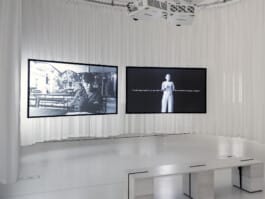
Exhibition at the Humboldt Forum, Berlin
Photo: Pierre Adenis
This two-channel video installation features interviews with two elderly migrants to the German Democratic Republic (East Germany) during the Cold War, as well as with the artist, who migrated 30 years after the fall of the Berlin Wall and is interested in the history of the GDR. In the interviews, they talk about the reasons for their migration, their lives, and their perception of German society, among other topics. The contrast between the experiences of old and new migrants illustrates the evolution of internationalisation in Berlin and the motivations behind immigration.
Migrants are hybrids who possess the cultures of both their country or region of origin and their country of immigration. Those who immigrated to the GDR probably adopted its culture as foreigners. However, as semi-outsiders, they were also able to view society more objectively. The same is true of today’s immigrants.
Exhibition at the Humboldt Forum, Berlin
Photo: Pierre Adenis
ostdeutsch/migrantisch
(East German/Migrant)
2024
Two-channel video installation
40’12”
This two-channel video installation features interviews with two elderly migrants to the German Democratic Republic (East Germany) during the Cold War, as well as with the artist, who migrated 30 years after the fall of the Berlin Wall and is interested in the history of the GDR. In the interviews, they talk about the reasons for their migration, their lives, and their perception of German society, among other topics. The contrast between the experiences of old and new migrants illustrates the evolution of internationalisation in Berlin and the motivations behind immigration.
Migrants are hybrids who possess the cultures of both their country or region of origin and their country of immigration. Those who immigrated to the GDR probably adopted its culture as foreigners. However, as semi-outsiders, they were also able to view society more objectively. The same is true of today’s immigrants.
Other Works on European and German History